TL;DR
- Laser, ultrasound and TENS work in three different ways, so “which is best” depends on your pain.
- Ultrasound is often chosen for recent injuries and tissue close to the surface.
- Laser is usually aimed at long-standing problems where healing has stalled.
- TENS calms the pain signal and is the one you can use at home between visits.
Three devices, three different mechanisms
Laser, ultrasound and TENS are often grouped together as “pain relief devices”, which hides the fact that they work on completely different biological targets. One stimulates cellular activity, one delivers mechanical energy into tissue, and one changes how pain signals travel to the brain. Choosing between them is less about which device is newest and more about what is actually happening in the tissue being treated.
Laser therapy, or photobiomodulation
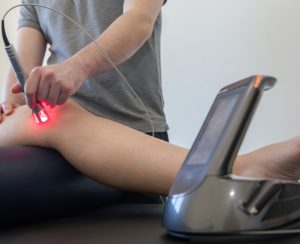
Therapeutic laser operates in specific wavelengths, typically 660 to 950 nanometers, which penetrate tissue at depths ranging from roughly 0.5 to 4 centimeters. The effect is photochemical rather than thermal. Light absorbed at the cellular level supports mitochondrial activity and local circulation, which is why it is generally applied to conditions where healing has stalled rather than to fresh inflammation.
Clinic-grade systems are not the same category of device as the handheld units sold direct to consumers. Class IV systems used in a clinical setting deliver considerably more power, which is what allows a measurable effect at depth without heating tissue. Laser therapy at Bay Way Pain is delivered as part of an assessed treatment plan rather than as a standalone device session.
- Penetration depth: roughly 2 to 4 cm for Class IV systems
- Treatment duration: about 5 to 20 minutes depending on the area
- Typical frequency: two to three sessions a week for acute presentations
- Evidence base: strongest for wound healing, moderate for musculoskeletal pain
- Cost profile: higher equipment cost, lower cost per treatment
Therapeutic ultrasound
Ultrasound has been in routine use for decades, which is both its strength and its weakness. It is familiar enough that the settings often go unexamined, and the settings are where the difference lies.
Frequency determines depth. One megahertz reaches roughly 2 to 5 centimeters, which suits deeper structures such as the hip joint or the lumbar paraspinals. Three megahertz stays superficial and suits tendon and scar tissue close to the surface. Duty cycle determines the type of effect: continuous output heats tissue, while pulsed output produces non-thermal mechanical effects such as acoustic streaming, which can support tissue repair without adding heat to an inflamed area.
- Frequency: 1 MHz for deep tissue, 3 MHz for superficial
- Intensity: commonly 0.5 to 2.0 W/cm² depending on the goal
- Duty cycle: continuous for heating, pulsed for mechanical effect
- Treatment area: two to three times the effective radiating area of the transducer
- Session length: around 5 to 10 minutes per area
TENS
TENS is often described only through gate control theory, blocking pain signals at the spinal level, but it works through more than one mechanism depending on the settings used.
High-frequency stimulation, around 50 to 100 Hz, activates large sensory fibres and produces segmental pain inhibition, which tends to feel immediate and wear off relatively quickly. Low-frequency stimulation, around 2 to 10 Hz, is associated with the release of the body’s own opioid-like compounds, which comes on more slowly and tends to last longer. Burst mode combines the two, which many people tolerate at higher intensities.
- High frequency, 50 to 100 Hz: fast relief, shorter duration
- Low frequency, 2 to 10 Hz: slower onset, longer lasting
- Burst mode: combines both patterns
- Electrode placement: dermatomal, myotomal or over a trigger point
- Treatment duration: 20 to 60 minutes, and it can be repeated at home
Choosing between them
The useful question is not which device is best, it is what the tissue needs. Where there is acute inflammation and swelling, the mechanical effects of pulsed ultrasound are often the better fit. Where healing has stalled in a chronic problem, laser is aimed at the cellular side of that. TENS sits apart from both: it does not treat the underlying pathology, it manages the symptom, and its main advantage is that it can be used at home between clinic visits.
Combination approaches are common, because symptom control and tissue repair are not the same objective. Pairing a clinic-based modality with home symptom control often makes more sense than picking a single device and expecting it to do both jobs. This is decided at the evaluation, alongside physical therapy and anything else in the plan.
What the evidence supports
The honest summary is that all three have support for some uses and thin support for others, and that the quality of the evidence varies with how carefully the parameters were controlled.
For laser, systematic reviews are generally more favourable for chronic musculoskeletal conditions such as neck pain and tennis elbow than for acute injury. For ultrasound, results look inconsistent until the settings are taken into account: heating an acutely inflamed area tends to produce poor outcomes, while pulsed application for tissue repair looks more consistent. For TENS, the research is limited by the difficulty of creating a convincing placebo and by the wide variation in settings between studies, so effectiveness varies with how it is set up and who it is used for.
None of this makes any of the three a guaranteed answer. It makes the assessment the important part.
A practical framework
Four factors decide the choice in most cases: how deep the target tissue is, how long the problem has been present, what the person tolerates, and what the treatment is meant to achieve.
- Acute, 0 to 6 weeks: ultrasound or high-frequency TENS
- Chronic, beyond 12 weeks: laser therapy or low-frequency TENS
- Deep tissue targets: laser therapy or 1 MHz ultrasound
- Superficial targets: 3 MHz ultrasound or localised TENS
- Ongoing symptom control at home: a TENS unit
Tolerance matters more than it is usually given credit for. Some people want to feel something happening, and the warmth of ultrasound or the tingle of TENS is reassuring. Others prefer a passive treatment such as laser that produces no sensation at all. Neither preference is wrong, and it is worth saying out loud at the evaluation.
Frequently Asked Questions
Which is better, laser or ultrasound?
Neither, in the abstract. They suit different situations. Ultrasound is often chosen for acute injury and superficial tissue repair, laser for chronic conditions where healing has stalled. The choice follows the diagnosis, not the other way round.
TENS vs ultrasound: which is better for knee pain?
They do different jobs. TENS eases the pain signal and can be used at home, while ultrasound works on the tissue itself during a clinic session. For knee pain, the choice depends on what is causing it, so it is decided at the evaluation.
Can a TENS unit replace clinic treatment?
It can manage symptoms between visits, which is useful, but it does not address what is causing the pain. It works best as part of a plan rather than instead of one.
Does any of this hurt?
No. Laser is usually felt as nothing or mild warmth, ultrasound as warmth or nothing at all, and TENS as a tingling or tapping sensation set to a level you find comfortable.
How many sessions will it take?
It depends on the condition, how long it has been there and what else is in the plan. All three are normally delivered as a course rather than a single visit, and progress is reviewed as it goes.
Is a home device the same as the clinic version?
For TENS, home units are genuinely useful and are often recommended. For laser and ultrasound, consumer devices operate at much lower power than clinical systems and should not be assumed to do the same thing.
Ready to talk about your pain?
Bay Way Pain Medical Care, 6010 Bay Pkwy, 6th Floor, Suite 603, Brooklyn. We accept most insurances.
Request an Appointment Call (718) 576-2001