TL;DR: There are ten well-established non-opioid options for persistent pain, and most people have only ever been offered one or two of them. They fall into four groups: hands-on treatment, device-based treatment, movement-based rehabilitation, and the daily factors that make pain better or worse. None is a cure on its own. The combination is what tends to work, and the right combination depends on what is causing the pain.
Why this list exists
Opioids have a place in acute pain. For pain that has lasted months, they carry known risks and diminishing returns, and most guidelines now place non-drug treatment first for persistent musculoskeletal pain.
The problem is not that alternatives do not exist. It is that they are scattered across different providers, covered differently by different plans, and rarely presented as a single menu. Here is that menu, with what each one is actually for.
Hands-on treatment
1. Joint mobilisation
Graded movement applied to a stiff or restricted joint to restore normal mechanics. Useful where a joint has become guarded after injury or after a long period of avoiding movement.
2. Soft tissue work
Targeted work on muscle and connective tissue that has shortened or become sensitised. Often what makes the difference between being able to start rehabilitation and not.
3. Neural mobilisation
Specific techniques for pain arising from an irritated nerve, such as symptoms that travel down the arm or leg. Different in intent from ordinary stretching.
Device-based treatment
4. Shock wave therapy
Shock wave therapy applies acoustic pulses to tendon and soft tissue problems that have stalled, such as plantar fasciitis or tennis elbow.
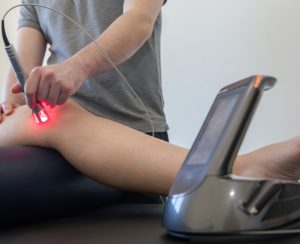
5. Laser therapy
Laser therapy, sometimes called photobiomodulation, is aimed at cellular activity and local circulation in tissue that is not healing on its own. Painless and requires no recovery time.
6. Magnetic field therapy
Magnetic field therapy is used for deeper musculoskeletal and nerve-related pain, generally as part of a course rather than as a single treatment.
7. Mechanical decompression
Traction-based systems such as Back On Trac and Knee On Trac take mechanical pressure off compressed structures. Relevant where nerve compression or joint loading is part of the problem.
Movement-based rehabilitation
8. Corrective exercise and neuromuscular re-education
This is the part that changes whether the pain comes back. It addresses how you move, which muscles are not contributing, and the compensations built up while you were protecting the painful area. Delivered through physical therapy.
9. Graded activity
Structured, progressive return to activity at a pace the tissue tolerates. Under-doing it and over-doing it both stall recovery, which is why the progression is planned rather than improvised.
Daily factors
10. Sleep, workstation set-up and stress
These are the least glamorous items on the list and among the most reliable. Poor sleep lowers pain tolerance measurably. A workstation that loads your neck for eight hours a day will undo an hour of treatment a week. Sustained stress keeps the nervous system in a state that amplifies pain signals.
They are worth treating as part of the plan, not as advice tacked on at the end.
How to use this list with your doctor
Bring it as questions rather than as requests. Which of these fit what I actually have? What is covered under my plan? What is the order, and how will we know within a few weeks whether it is working?
A good plan usually combines something that reduces symptoms now with something that changes the mechanics over time. A plan made only of the first kind tends to plateau.
Frequently Asked Questions
Do non-opioid treatments work as well as medication?
For persistent musculoskeletal pain, non-drug approaches are what most guidelines place first, because they address function rather than only sensation. Results vary by condition and by person, and combinations generally outperform single treatments.
Which of these does insurance cover?
Physical therapy is covered by most plans, including Medicare and Medicaid, usually with a referral or authorisation. Device-based treatments vary. It is worth asking before a course is booked.
How long before something changes?
Weeks rather than days for most of these, and they are normally given as a course. If there is no movement after several weeks, the plan should be reviewed rather than simply continued.
Can I stop my pain medication once I start these?
That is a decision for the clinician who prescribed it, and stopping some medications abruptly is not safe. Non-drug treatment is often used to reduce reliance over time rather than to replace medication overnight.
What if none of these suit my case?
Then the diagnosis is the place to look again. Treatment that does not fit the cause will not work however well it is delivered.
Talk to someone in Brooklyn
An evaluation establishes which of these ten are relevant to your case, and in what order. Call (718) 576-2001 or request an appointment at our Brooklyn office on Bay Parkway.