TL;DR: A first cold laser session in Brooklyn starts with an evaluation, not the laser. The treatment itself is short, usually a few minutes per area, and most people feel either nothing or a mild warmth. You wear protective eyewear, nothing is injected, there is no numbing and no downtime. Laser is normally given as a course of sessions rather than a single visit, and it works best alongside the rest of your plan.
Before the laser: the evaluation
Nothing is treated before the cause is understood. A first visit covers your history, what makes the pain better or worse, previous imaging and any medications you take. The point is to establish whether your pain is coming from tissue that responds to laser therapy, and whether anything in your history rules it out.
That matters, because the same knee pain can come from arthritis, a tendon, a meniscus or referred pain from the back, and those do not all call for the same plan.
What cold laser therapy is
Cold laser, also called low level laser therapy or photobiomodulation, uses specific wavelengths of light applied to the skin over the painful area. The light is absorbed by tissue, where it is used to support cellular activity and local circulation. It does not cut, burn or heat tissue the way a surgical laser does, which is where the word “cold” comes from.
It is non-invasive and drug-free, which is why it is often chosen by people who want to avoid injections or cannot take certain medications.
Step by step through the session
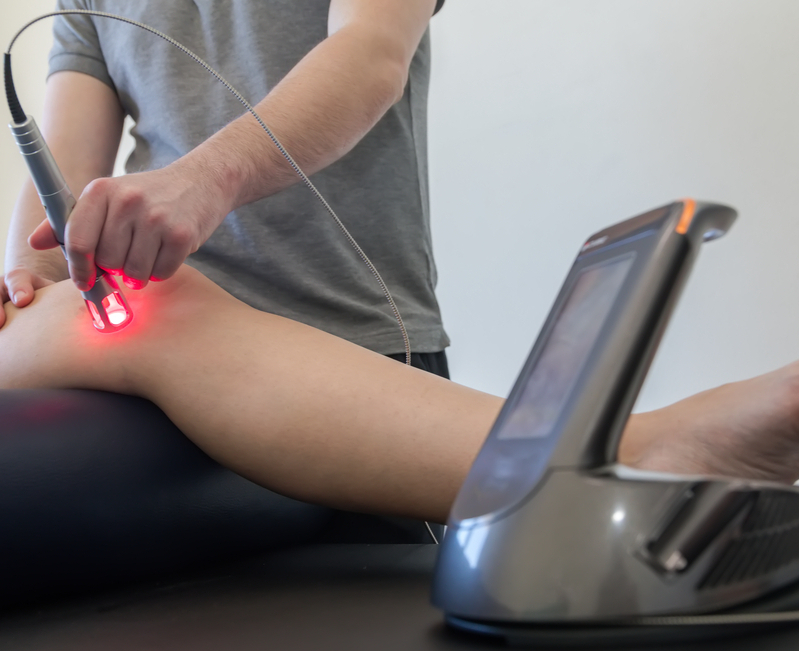
- You stay dressed, apart from exposing the area being treated. The applicator has to contact skin, so loose clothing around the site helps.
- Everyone in the room wears protective eyewear. This is standard and non-negotiable, including for the clinician.
- The applicator is moved over the area, or held in place, depending on the protocol chosen for your case.
- Treatment time is short. Most areas take a few minutes. A session covering more than one area still tends to be brief.
- You will feel very little. Most people report either no sensation or a gentle warmth. It should never be painful.
- You leave and carry on with your day. No sedation, no recovery period, no restriction on driving.
What to bring and how to prepare
- Your insurance card and a list of current medications, including anything photosensitizing
- Any recent imaging reports for the area, if you have them
- Clothing that gives easy access to the painful area
- Skip heavy creams, oils or makeup on the treatment site that day
After your first session
There is no downtime. Some people notice a change in symptoms early, others notice nothing after one visit, and neither tells you much on its own. Laser is normally delivered as a course, with progress reviewed as the sessions go on, so the honest answer after session one is that it is too early to judge.
Keep doing the rest of your plan. Laser is usually combined with physical therapy or other treatments rather than used alone, because reducing pain is not the same as fixing the mechanics that caused it.
Tell your clinician if any of these apply
- You are pregnant
- You have a current or past cancer diagnosis
- You take medication that increases light sensitivity
- You have an implanted device, or any active infection or open wound at the site
- You have thyroid conditions, if the neck is the area being treated
None of these is automatically a barrier, but each one changes the decision, which is why the history is taken first.
Frequently Asked Questions
Does cold laser therapy hurt?
No. Most people feel nothing at all, or a mild warmth over the area. If anything feels hot or sharp, say so during the session and it is adjusted.
How long is a laser session?
The laser part is short, usually a few minutes per area treated. Your first visit takes longer overall because it includes the evaluation.
How many sessions does it take?
It depends on the condition, how long it has been there and what else is in your plan. Laser is given as a course rather than a one-off, and the number is set after your evaluation.
Is cold laser the same as the laser used in surgery?
No. Surgical lasers cut or heat tissue. Cold laser uses much lower power levels and is applied to the skin without breaking it.
Can I have laser therapy if I am on blood thinners?
Laser does not involve needles or incisions, so it is usually straightforward, but bring your full medication list to your evaluation so it can be reviewed properly.
Book a first session in Brooklyn
If you want to know whether cold laser suits your pain, start with the evaluation. Call (718) 576-2001 or request an appointment at our Brooklyn office on Bay Parkway.